Say the whole thing
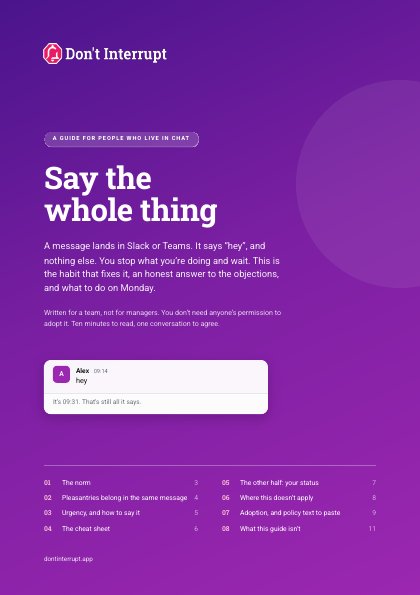
A message lands in Slack or Teams. It says “hey”, and nothing else. You stop what you’re doing and wait. This guide is the habit that fixes it, an honest answer to the objections, and what to do on Monday.
Put the ask, the context and the urgency in the first message.
Send your hello in that message, not instead of it. Here’s the same request, sent by the same person on the same morning. Both are friendly. Only one is finished.
Eight short sections. Ten minutes to read, one conversation to agree. Written for a team, not for managers: you don’t need anyone’s permission to adopt it.
What goes in a first message, and what an incomplete one costs the person reading it.
The “this makes teams cold” objection, answered. Keep the warmth and send it with the request.
Three levels, now, today and by a date, and why “no rush” doesn’t help.
Six messages people really send, each rewritten whole.
A status that’s true, says when it ends, and says what to do if it’s urgent.
Emergencies, social chat, thinking out loud, and conversations that shouldn’t be in a message at all.
Five steps for a team, the reply that makes it stick, and wording for a handbook.
Not proof, not a clinical tool, not a rule for everything. With sources.
From section seven. Put it in your handbook, team charter or channel topic, and change the wording to sound like your team.
When you message a colleague with a request, put the ask, the context and the urgency in the first message. Don’t send a greeting on its own and wait for a reply before saying what you need.
Pleasantries are welcome. Send them in the same message as the request rather than instead of it.
State urgency explicitly: now, today, or by a named date such as “before Friday”. “Now” is for work that is genuinely blocked or time critical. Avoid “whenever”, which leaves the reader to schedule your request for you.
Where a message could reasonably be read as concerning, say plainly that it isn’t, for example: “nothing’s wrong”.
Keep your chat status honest, and use Do Not Disturb for focused work. A status that says when you’ll be back, and how to reach you if it’s truly urgent, is part of the same courtesy.
This applies to transactional messages. It doesn’t apply to social conversation, to emergencies, or to sensitive personal matters, which are better handled in a conversation than in a message.
Replying “what’s the ask?” to an incomplete message is an accepted and friendly response, not a criticism.
A complete message fixes the sender’s side. A status that says you’re in a meeting until three fixes the reader’s side. Don't Interrupt sets your Slack and Microsoft Teams status, presence and Do Not Disturb from your calendar and working hours, so colleagues can tell when to wait.