If you want Slack or Microsoft Teams to pause notifications whenever you’re in a meeting, without remembering to do it each time, you need something that reads your calendar. Don’t Interrupt does that: it sets your status and turns on Do Not Disturb for as long as each meeting runs, then turns it off again. Try it free with Slack or Teams.
What Slack and Teams do on their own
Both apps let you quieten notifications by hand. As far as their help pages describe, neither switches Do Not Disturb on from your calendar.
- Slack, “Pause notifications”. When you set a status by hand you can tick “Pause notifications”, and notifications stay paused until that status clears. It works, but you have to do it for every meeting.
- Slack, notification schedule. You pick hours for every day, weekdays only, or custom times for each day. It’s available on every plan, including Free. It follows the clock, so it can’t know that a meeting moved to 3pm on Thursday.
- Slack’s Google Calendar and Outlook Calendar apps. They set a status such as “In a meeting”. Their help pages don’t describe turning on Do Not Disturb.
- Microsoft Teams. Teams shows you as Busy during a meeting, based on your Outlook calendar. Busy keeps notifications on. Do Not Disturb is the setting that stops banners, and Microsoft’s docs describe it as a manual choice with a duration. Quiet time on mobile works by hours or days and doesn’t follow your calendar.
So the gap is the same on both: a Do Not Disturb that follows your calendar. That is what the rest of this page sets up.
Mute or pause: which one do you want?
People search for both words, and they aren’t quite the same thing.
- Muting usually means one channel or conversation. You stop hearing from a noisy channel, but everything else still comes through.
- Pausing (Slack’s word) or Do Not Disturb (the name in both apps) silences everything for a period of time.
For a meeting you almost always want the second. The point is to stop the next message pulling your eyes off the call, whoever it’s from. Don’t Interrupt turns on Do Not Disturb for the length of the event and switches it off when the event ends, so you can read what you missed afterwards.
How to pause notifications when you’re in a meeting
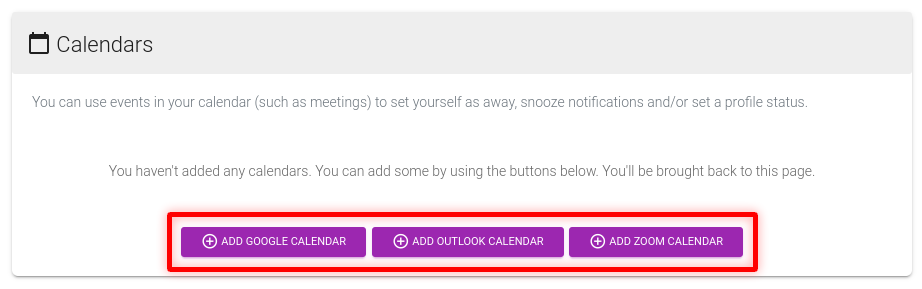
Step 1: Add a calendar
Sign up with Slack or Teams, then link your Google, Outlook or Zoom calendar from the dashboard. An iCal link also works.
Step 2: Set your status and turn on Do Not Disturb
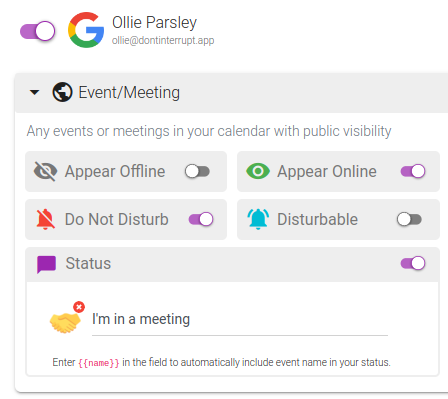
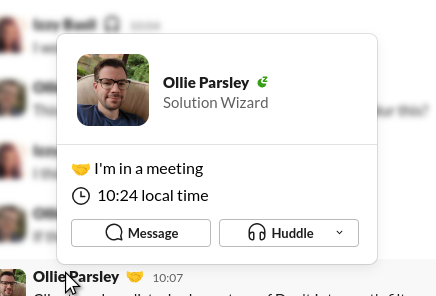
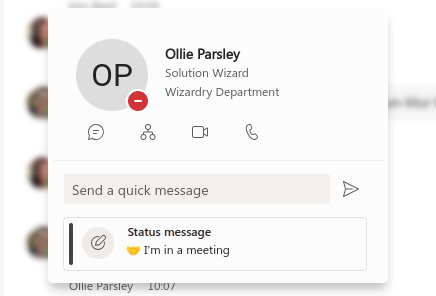
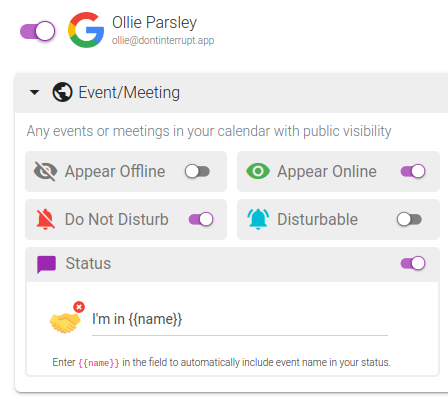
Open the calendar’s Event/Meeting settings. Switch on Do Not Disturb to snooze notifications from the moment a meeting starts until it ends. Switch on Status to set a message and emoji at the same time, so colleagues know why you’re quiet. Private events have their own settings, so you can show something more generic for those.
|
|
Step 3: Optional: put the meeting name in your status
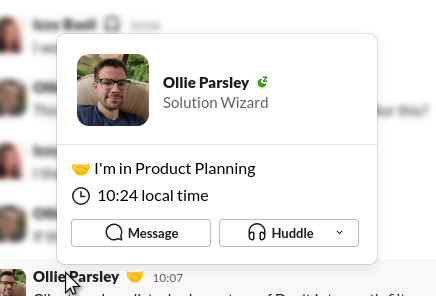
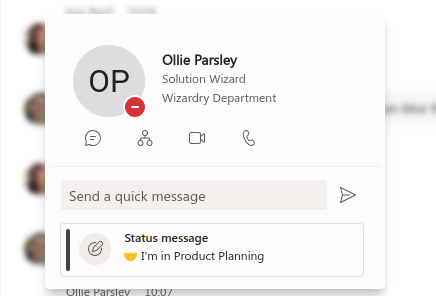
Type {{name}} in the status text and it’s replaced with the title of each meeting, so “In {{name}}” becomes “In Product Planning”. It’s off by default, and private events show “Private event” rather than their title.
|
|
For a longer walkthrough of the Slack side, see Slack status with meeting name and Do Not Disturb.
Pause Slack notifications from Google Calendar
This is the most common setup, and the search is usually some version of “slack pause notifications when in meeting google calendar”. Connect Slack, add your Google Calendar, and follow the steps above. Don’t Interrupt reads the events on your calendar, and for each one that matches your settings it asks Slack to snooze notifications until the event ends and to set your status.
Slack’s own Google Calendar app can set an “In a meeting” status, but its help page doesn’t describe turning on Do Not Disturb. That’s the part this adds. Because Do Not Disturb has its own switch, you can also use it with no status text at all.
Pause notifications from Outlook
Add your Outlook or Microsoft 365 calendar in the same place. The settings are identical, and it works with a Slack account or a Teams account.
One catch: since late 2025 many Microsoft work tenants stop people granting calendar access themselves, so a new connection can need an IT admin to approve it. If you can’t wait, add the calendar with its iCal link instead, which Don’t Interrupt accepts as a calendar. Slack’s own Outlook Calendar app reads only your primary calendar, so it’s worth checking where your meetings live.
Pause notifications during Zoom calls
If you spend time on Zoom calls that never make it into your calendar, connect Zoom as well. Choose Add Zoom Calendar on the dashboard, authorise it, then switch the Zoom calendar on in your schedule. You get a status and Do Not Disturb while you’re in a call. The Zoom guide has the full steps.
Pause Microsoft Teams notifications in meetings
Teams is where the difference between the settings matters most.
| Teams setting | What it does | Silences notifications? |
|---|---|---|
| Busy | Shown during a meeting, based on your Outlook calendar | No, Busy keeps notifications |
| Do Not Disturb | Stops banners, and calls go to voicemail unless the caller is on your priority access list | Yes |
| Appear offline | Shows you as offline | No, Microsoft says you still receive notifications |
Teams sets Busy for you when your Outlook calendar has a meeting. For the length of the event, Don’t Interrupt asks Teams for Do Not Disturb instead, which overrides that Busy. It also works when your meetings are on a Google Calendar, which Teams’ own presence documentation doesn’t mention reading. The Google Calendar to Teams guide covers that case.
Limits worth knowing
- Changes land within about five minutes. Event times round up to five-minute boundaries, so Do Not Disturb can start a little after the meeting does and end a little after it finishes.
- Your own status wins. If you’ve set a status by hand, Don’t Interrupt leaves it alone.
- The free plan adds a short tag (” • dontinterrupt.app”) to statuses it sets. Paid plans can remove it.
- Teams “Appear offline” doesn’t silence notifications. Use Do Not Disturb for that.
Frequently asked questions
How do I make Slack pause notifications when I’m in a meeting?
Connect your calendar to Don’t Interrupt and switch on Do Not Disturb in the meeting settings. It then snoozes Slack for the length of each event. Slack’s own “Pause notifications” tick box is manual, and its notification schedule follows the clock rather than your calendar.
Can Slack do this on its own with Google Calendar?
Slack’s Google Calendar app sets an “In a meeting” status. Its help page doesn’t describe turning on Do Not Disturb, so for a calendar-driven pause you need another tool such as Don’t Interrupt.
How do I mute Slack notifications during meetings automatically?
Muting usually applies to a single channel, so what you want is Do Not Disturb. Don’t Interrupt switches it on at the start of each calendar event and off at the end, so you don’t touch anything.
Does it work with Microsoft Teams?
Yes. It sets your Teams status message and asks Teams for Do Not Disturb during each event, which stops banners. Teams’ own Busy status keeps notifications on.
Will it overwrite a status I set myself?
No. If you’ve set a status by hand, Don’t Interrupt leaves it alone until you clear it.
How quickly does it switch on?
Within about five minutes of the meeting starting or ending, because event times round up to five-minute boundaries.
Is it free?
There’s a free Basic plan for one calendar and one Slack or Teams account. It adds a short tag to your status. See pricing for the paid plans, which remove the tag and add more calendars and rules.
Can I pause notifications for Zoom calls as well?
Yes. Connect Zoom as a calendar and the same status and Do Not Disturb settings apply while you’re in a call.