To set a lunch status in Microsoft Teams or Slack every day without touching it, put “lunch” in your calendar and let a calendar rule do the rest. Don’t Interrupt sets your status message, and optionally Do Not Disturb, while the event runs, then clears it when lunch is over. Try it free with Slack or Teams.
How to set a lunch status in Microsoft Teams
Teams lets you set a status message by hand and choose when it clears. Microsoft’s docs don’t describe a recurring schedule for it, so on your own you’d set it again every day. Here is how to make it happen from your calendar instead.
Step 1: Connect Teams and your calendar
Sign up with Microsoft Teams, then add your Outlook, Google or iCal calendar from the dashboard. Your calendar and your Teams account are separate connections, so a Google Calendar can drive a Teams status.
Step 2: Add a recurring “Lunch” event
In your calendar, create an event called “Lunch” at your usual time and set it to repeat on weekdays. The word is all Don’t Interrupt needs to find it. Matching ignores capitals and looks for the whole word in the event name, so “Team lunch” and “Lunch at Mario’s” both match. Paid plans can also match on the event’s description or location.
Step 3: Create a Calendar Rule for “lunch”
On your schedule, find the Calendars Rules card and choose Add Rule. In the Phrases box, type lunch. On the right, choose what should happen when an event matches:
- Status: switch it on and type something like “Out for lunch”, with a sandwich emoji if you like. On Teams the emoji is folded into the text.
- Do Not Disturb: switch it on if you want Teams banners silenced. Without it, Teams shows whatever presence it would normally show.
- Appear Offline: use with care. Teams still delivers notifications to someone who appears offline, and if you switch on both Appear Offline and Do Not Disturb, Teams ends up showing Offline without the silence.
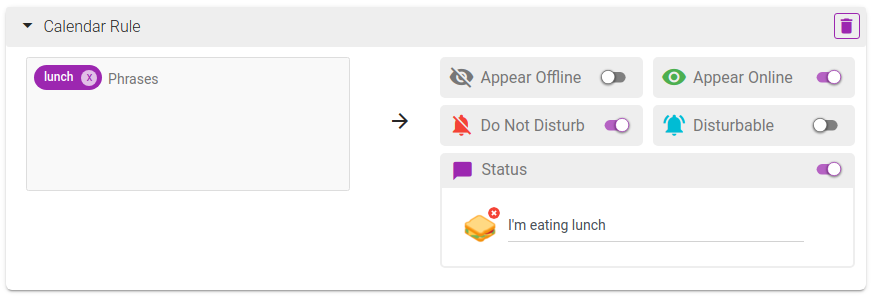
Save the schedule. The next time an event with “lunch” in it starts, your status changes, and it clears when the event ends.
How to set a lunch status in Slack
Slack lets you schedule statuses, but only up to five at a time, and each is a one-off start and end window. Its help pages don’t describe a repeating option, so a daily lunch would mean rescheduling. The setup above works the same way for Slack:
- Sign up with Slack and add your Google, Outlook or iCal calendar.
- Add the recurring “Lunch” event.
- Add the same Calendar Rule on the phrase
lunch, with a status such as “Out for lunch” and an emoji. Slack allows about 100 characters of status text.
Switch on Do Not Disturb in the rule if you want notifications paused for the hour, or leave it off to stay reachable.
Set your lunch status from Outlook
If your calendar is Outlook, the steps are the same, and nothing needs installing in Outlook itself:
- Create a recurring Outlook event named “Lunch” on weekdays.
- In Don’t Interrupt, add your Outlook calendar.
- Add a Calendar Rule on the phrase
lunch, as above.
One catch for work accounts: since late 2025 many Microsoft tenants stop people granting calendar access themselves, so a new Outlook connection can need an IT admin to approve it. If you can’t wait for that, use the calendar’s iCal link instead. An iCal calendar works for the lunch rule too.
How many lunch rules do I get?
The free Basic plan has one rule with one phrase, which is enough for “lunch”. Plus has five rules and five phrases, and Pro has 20 rules and 10 phrases. That lets you add other phrases to the same rule, such as “dinner” or “gym”, or separate rules for a focus block or the school run. Plans are on the pricing page.
Limits worth knowing
- Changes land within about five minutes. Event times round up to five-minute boundaries, so your lunch status can appear a little after the event starts and clear a little after it ends.
- Your own status wins. If you’ve set a status by hand, Don’t Interrupt leaves it alone.
- The free plan adds a short tag (” • dontinterrupt.app”) to statuses it sets. Paid plans can remove it.
- Teams “Appear offline” doesn’t silence notifications. Use Do Not Disturb for that.
Frequently asked questions
How do I set a lunch status in Microsoft Teams?
You can set a status message by hand in Teams and choose when it clears. To have it set automatically every day, add a recurring “Lunch” event to your calendar and create a Calendar Rule in Don’t Interrupt on the phrase “lunch”. The status is set while the event runs.
Can Microsoft Teams schedule a recurring status?
Microsoft’s documentation doesn’t describe a recurring schedule for status messages or presence. That’s why a calendar-driven tool is the practical route.
How do I set a lunch break status in Slack?
Add a recurring “Lunch” event, then add a Calendar Rule on “lunch” with the status and emoji you want. Slack’s own scheduled status allows five at a time, each as a one-off window, and the docs don’t describe repeating them.
Does it work if my calendar is Outlook?
Yes. Some companies make an IT admin approve access to Outlook calendars, and an iCal link is the fallback if you can’t wait.
Can I silence notifications during lunch too?
Yes. Switch on Do Not Disturb in the same rule. On Teams, don’t rely on Appear Offline for this, because Teams still delivers notifications to someone who appears offline.
Is it free?
The free Basic plan includes one rule with one phrase, which covers lunch. It adds a short tag to statuses it sets, and paid plans remove it.